Thanksgiving Week Is Monarch Count Week at Natural Bridges and Lighthouse Field
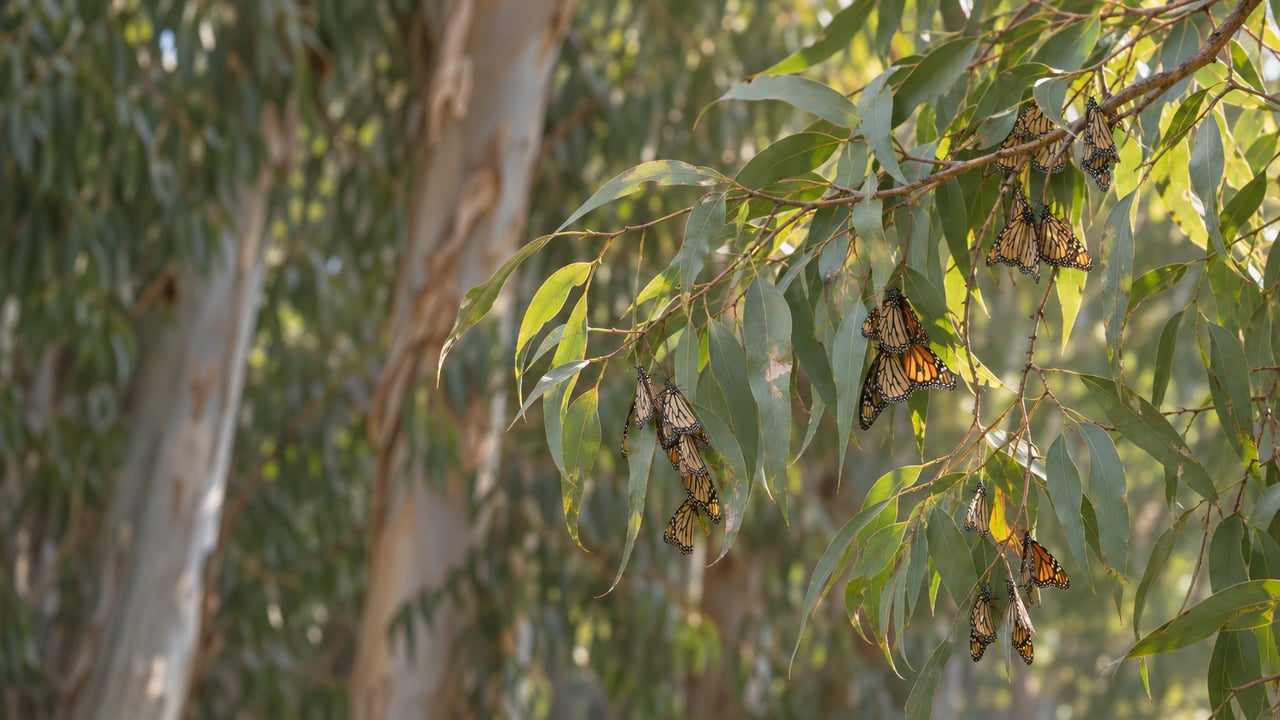
"We had 120,000 in 1997," Natural Bridges docent Kirk Crane told KAZU at this October's Welcome Back Monarchs festival. "You'd go through that grove down there, and they would just be roped with huge clusters the size of you and me."
The grove at the end of West Cliff Drive doesn't hold that many butterflies anymore. Its importance has gone the other way, though. In the leanest recent winters, Natural Bridges and Lighthouse Field, the Westside's two counted groves, have held a much bigger share of the western monarch population than they did when the numbers were high. This week is when those groves get counted.
Volunteers with the Xerces Society's Western Monarch Count survey overwintering sites three times a season. In 2026 the early count ran Oct. 17 to Nov. 1. The mid-season count, known as the Thanksgiving Count, runs Nov. 14 through Dec. 6, and the late count runs Dec. 26 through Jan. 10, 2027. That puts the Thanksgiving Day publish date of this post right in the middle of the mid-season window. Any grove walk this week falls inside it.
The timing also matches local viewing advice. California State Parks says late October and all of November are the best time to see monarchs at Natural Bridges, and that the butterflies usually arrive in mid-October and leave by mid-February. Visit Santa Cruz puts the Natural Bridges peak in late November and early December. For anyone already on the Westside, the busiest weeks for the butterflies and the busiest week for houseguests land together.
According to the Xerces Society's site-by-site table, the Natural Bridges count has swung widely over the past several seasons. Here are its counts next to the total counted across the West in the same years:
| Count year | Natural Bridges | Western total | Natural Bridges share |
|---|---|---|---|
| 2018 | 1,120 | 27,721 | about 4% |
| 2020 | 550 | 1,901 | about 29% |
| 2022 | 7,500 | 335,479 | about 2% |
| 2023 | 6,500 | 233,394 | about 3% |
| 2024, mid-season | 1,400 | 9,119 | about 15% |
| 2025, mid-season | 2,500 | 12,260 | about 20% |
In the big rebound of 2022, Natural Bridges' 7,500 monarchs came to about one in every 45 counted in the West. During the 2025 Thanksgiving Count the grove's 2,500 came to about one in five of the 12,260 tallied across 249 sites. Xerces called that total the third lowest since the count began. In its January 2026 release, the Xerces Society named Natural Bridges the highest-count site in Santa Cruz County for the 2025 season, with 2,500 butterflies counted in early December.
The grove can also change a lot within a single season. The 2025 early count at Natural Bridges, taken Oct. 29, 2025, found 1,100 monarchs. That figure more than doubled by the Thanksgiving Count and then fell to 1,540 in the late count over the New Year's period. The previous winter, the 2024–25 late count at Natural Bridges recorded zero. The mid-season window is the one that has caught the grove near its fullest in recent years.
Natural Bridges gets the festival and the boardwalk, but Lighthouse Field is the Westside's other counted grove. In the Xerces table, the site listed as Lighthouse Field, Santa Cruz, counted 1,078 monarchs in the 2024 mid-season count and 978 in the 2025 mid-season count. Natural Bridges counted 1,400 and 2,500 in those same two windows.
Together the two sites had 3,478 monarchs in the 2025 Thanksgiving Count, about 28% of the 12,260 counted across the West in that window. Elsewhere in the city the numbers are much smaller. The UCSC Arboretum recorded a single monarch in 2025, and the Moore Creek row has no count entered for 2024 or 2025. Across the harbor, the Moran Lake grove in Live Oak has its own fall story, which we covered in our post on the East Cliff bike path and monarch habitat plan.
Monarchs pick their winter groves partly for shelter, and both groves are shelter from the wind. "They pick the overwintering sites that they do partly for wind protection," Rhiannon Sims of the Santa Cruz District of California State Parks told KAZU in October. "But if we have a big storm that comes through, sometimes even being in the grove isn't enough to protect them."
This winter is an El Niño season, and in the same story Xerces Society conservation biologist Isis Howard said, "We're concerned that this winter could damage groves, result in more monarch mortality than we've seen in past seasons." How hard this El Niño hits the coast is still unknown.
The trees take a long time to replace. In the Santa Cruz Sentinel's December 2025 coverage, Howard stressed protecting roost sites because new trees take decades to grow. In the same story, Natural Bridges senior park aide Haley Hernandez described the monarchs feeding on eucalyptus flowers during the winter. One reuse of a fallen tree is already on the ground. In January the Sentinel photographed a hand-built walkway to the grove made from rounds of a downed eucalyptus.
The mid-season window has been when Natural Bridges is fullest, and the big winter storms, if they come, are still ahead.
According to California State Parks, Natural Bridges State Beach is open from 8 a.m. to sunset. The visitor center is open daily from 11 a.m. to 4 p.m. between Oct. 1 and Jan. 31. An accessible boardwalk leads into the grove and ends at an observation deck, and strollers and wheelchairs can use it. Parking inside the park costs $10 per vehicle for day use. Walking in is free, and the entrance is at 2531 West Cliff Drive.
Friends of Santa Cruz State Parks lists guided monarch tours at 11 a.m. and 2 p.m. on fall and winter weekends. For a group of visiting relatives, the Saturday or Sunday after Thanksgiving fits that schedule. On a weekday you can walk the grove on your own, and the boardwalk is open then too.
What you see depends on the temperature. According to the Xerces Society's viewing guide, monarchs flutter and fly on sunny mornings or afternoons above 55°F, and they stay in clusters on cool early mornings and overcast days. State Parks says the butterflies at Natural Bridges cluster when it drops below 60°F. A gray morning before the turkey goes in is a good time to see the hanging clusters. A clear, warm afternoon after the meal is better for seeing them fly. Binoculars help either way, and the posted guidance asks visitors to watch quietly and not touch the butterflies.
Our team at Room Real Estate follows the count from the Westside every fall. If your plans include a move within walking distance of West Cliff, or you'd like to know what your current home might bring, request a quote and we'll put together a plan with the same local detail.
Stay up to date on the latest real estate trends.

You've got questions and we can't wait to answer them.